
Cuneiform Writing: How Mesopotamia Invented the First Writing System
Around 3400 BCE, in the Sumerian city of Uruk, people began pressing marks into wet clay that others could read back — not just recognise, but read, word for word. That act was the birth of cuneiform, the world's oldest known writing system, and it marks the point where human history stops being purely oral and starts leaving a record.
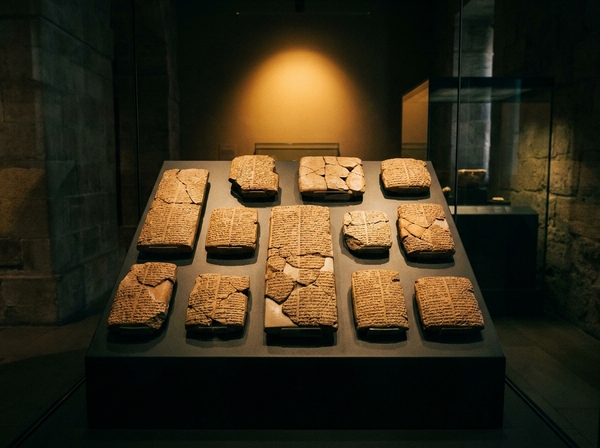
At Slemani Museum in Sulaymaniyah, Kurdistan Region, Iraq, cuneiform tablets and inscribed objects sit within reach of visitors — not behind glass in a country thousands of miles from where they were made, but in the region that produced them. This guide covers how the script developed, what it was used for, and why it still matters.
What Is Cuneiform Writing?
"Cuneiform" comes from the Latin cuneus ("wedge") and forma ("shape") — a 17th-century European description of marks made by pressing a cut reed stylus into soft clay. Once the clay dried or was fired, the impression was permanent.
It wasn't a script tied to one language. Over roughly 3,000 years, cuneiform was adapted to write at least fifteen languages, including Sumerian, Akkadian, Babylonian, Assyrian, Hittite, and Elamite — each borrowing and modifying the same wedge-based sign system for grammar it wasn't originally built for.
From Tokens to Tablets: How Writing Began
Cuneiform has a traceable ancestor: small clay tokens used across Mesopotamia for thousands of years before writing existed, to track livestock, grain, and other goods.
By around 3500 BCE, administrators in Uruk started sealing these tokens inside clay envelopes, then marking the outside to show what was sealed within — so nobody had to break the envelope to check its contents. The next step was the important one: someone realised the marks alone carried the information. The tokens became unnecessary. That realisation is, functionally, the invention of writing.
The earliest tablets reflect this origin plainly — they're inventories, grain counts, worker rosters. Writing began as an administrative tool for economies that had outgrown human memory, not as a medium for literature or record-keeping in the modern sense.
How the Script Evolved
From Pictures to Abstract Signs
Early signs were recognisable pictures — a head, a fish, a jar. As scribes wrote faster and stylus technique changed, these pictures compressed into wedge combinations that no longer resembled their origins. By roughly 2500 BCE, most signs had become phonetic, representing sounds rather than objects — the same shift every mature writing system eventually makes.

From Accounting to Everything Else
By the Early Dynastic period (2900–2350 BCE), cuneiform had moved well past bookkeeping. Kings inscribed military victories on stone monuments. Priests recorded temple rituals and hymns. Scholars compiled sign lists with their meanings — the earliest known reference works. By the time of Babylon, cuneiform carried literature: the Epic of Gilgamesh, the oldest written narrative we have, survives on twelve clay tablets.
Reading Cuneiform Was a Trained Skill, Not a Given
A working scribe needed several hundred signs memorised, and most signs had more than one reading — as a full word, a syllable, or a modifier attached to another sign. Reading a tablet meant knowing the script, the grammar, and the vocabulary of whichever of the fifteen-plus languages it was written in.
Scribes trained from childhood in schools called edubba — literally "tablet house." Training meant copying standard texts, memorising sign lists, and drilling the physical technique needed to produce a legible impression. It was a long apprenticeship into a genuinely prestigious profession.
What Cuneiform Tablets Reveal About Daily Life
Hundreds of thousands of tablets survive — most still untranslated — and what they record is unglamorous in the best way:
- Contracts and disputes — merchants trading over distance, loans at interest, arguments over damaged goods
- Personal letters — family correspondence, complaints, requests for help
- School exercises — a student's tablet with the same sign copied dozens of times, mistakes visibly scratched out
- Medical texts — diagnosis and treatment notes, some still recognisable to modern medicine
- Astronomical logs — systematic sky observations that became the foundation of Babylonian astronomy
- Legal codes — including the Code of Hammurabi, among the earliest surviving written law
These aren't ceremonial records. They're paperwork — which is exactly why they're valuable: they show how ordinary people actually lived, argued, and kept track of things.
Cuneiform at Slemani Museum
The collection at Slemani Museum includes cuneiform tablets and inscribed objects tied directly to the civilisations above. The museum sits inside the historical footprint of Mesopotamia itself — the region now spanning Iraq and Kurdistan was home to major Sumerian, Akkadian, Babylonian, and Assyrian centres.
Seeing these objects in person changes them. A 4,000-year-old tax record is, at its core, someone's paperwork — proof that the people who invented writing dealt with the same obligations and record-keeping pressure we do now.
For the wider civilisations behind these artefacts, see our guide to Mesopotamian civilisations from Sumer to Assyria.
Why Cuneiform Disappeared
Cuneiform fell out of use over the final centuries BCE as alphabetic scripts — Aramaic especially — proved simpler to learn and easier to carry, written on papyrus and parchment rather than fired clay. The last known cuneiform text is an astronomical almanac dated to 75 CE, written by a Babylonian priest who was likely one of the last people alive able to read it.
The script then went unread for close to two thousand years. Its decipherment in the 19th century — largely through Henry Rawlinson's work on the trilingual Behistun Inscription — reopened a written record of human history that had been sealed for nearly two millennia.
FAQ
How old is cuneiform writing?
The earliest cuneiform dates to around 3400–3200 BCE in Sumer, making it the oldest known writing system, alongside Egyptian hieroglyphs as a contender depending on dating methods used.
What was cuneiform originally used for?
Accounting — tracking grain, livestock, and labour for economies too large to manage by memory alone. Literature, law, and religious texts came centuries later.
How many cuneiform signs are there?
At its peak, several hundred signs were in active use, though the full historical sign list (across all periods and languages) runs into the thousands.
Can anyone read cuneiform today?
Yes — a small number of specialists (Assyriologists) can read it, and most tablets held in museum collections worldwide remain untranslated due to the sheer volume that survives.
Why did cuneiform stop being used?
Alphabetic scripts like Aramaic were faster to learn and write on portable materials, gradually replacing cuneiform between roughly 500 BCE and 75 CE.
Visit Slemani Museum
Sulaymaniyah is one of the most direct entry points anywhere for encountering Mesopotamian history first-hand. Slemani Museum holds one of the most significant artefact collections in the Kurdistan Region — a place where the history of cuneiform is preserved physically, not just described. See our guide to the museum's collection for what to expect on a visit.
